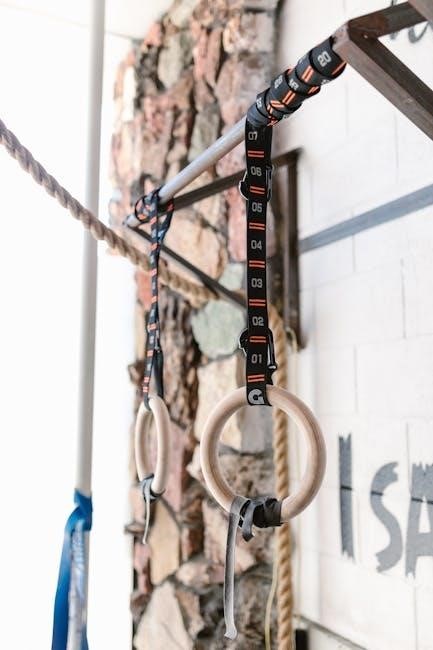
Gym-free workouts are increasingly popular, offering a versatile and affordable fitness solution, especially with tools like the TRX HOME2 for full body workouts.
Suspension training, pioneered by TRX, provides a unique approach to strength training, differing from traditional weight training methods and gaining momentum.
These workouts are ideal for busy lifestyles, offering a convenient way to achieve fitness goals, and are becoming a staple in modern home gym setups.
What is a Suspension Trainer?
Suspension trainers, like the renowned TRX, are innovative fitness tools utilizing bodyweight for resistance. Originally developed by a U.S. Navy SEAL, Randy Hetrick, during deployments where traditional gym access was limited, these trainers have evolved into a mainstream fitness staple.
Essentially, a suspension trainer consists of adjustable straps with handles or foot cradles, anchored to a secure point. This seemingly simple design allows for a remarkably diverse range of exercises, targeting multiple muscle groups simultaneously. Unlike fixed-weight machines, suspension trainers demand constant core engagement and stabilization, enhancing functional strength.
The core principle revolves around leveraging gravity and body position to modify exercise intensity. By adjusting your angle relative to the anchor point, you control the difficulty, making it suitable for all fitness levels. This adaptability is a key reason for their growing popularity in gym-free workouts and home gyms;
Benefits of Suspension Training
Suspension training offers a multitude of advantages, making it a compelling fitness choice. Its core benefit lies in its versatility – a single trainer facilitates full body workouts, targeting strength, balance, flexibility, and core stability. This contrasts with specialized gym equipment requiring significant space and investment;
Because exercises utilize bodyweight, it’s inherently scalable. Adjusting the trainer’s angle directly modifies the difficulty, catering to beginners and advanced athletes alike. This progressive overload is crucial for continuous improvement. Furthermore, the unstable environment forces constant muscle activation, enhancing functional strength applicable to everyday movements.
The portability of trainers like the TRX HOME2 makes it ideal for gym-free workouts, fitting seamlessly into busy lifestyles. It’s a cost-effective solution, offering a comprehensive workout without the need for expensive gym memberships or bulky equipment.
TRX vs. Other Suspension Trainers
While numerous suspension trainers exist, TRX stands out as the original and arguably most recognized brand. Founded by U.S. Navy SEAL Randy Hetrick, born from a need for fitness during deployment, TRX established the category and continues to innovate.
However, the market now includes viable alternatives. These often aim to provide similar functionality at a more accessible price point. Key differentiators lie in build quality, handle comfort, and included training resources. Some brands focus on specific features, like enhanced adjustability or integrated digital workouts.
Ultimately, the “best” trainer depends on individual needs and budget. TRX benefits from brand recognition and a robust ecosystem of certified trainers and content. Other options may suffice for those seeking a basic, effective gym-free workout solution, like the TRX HOME2, prioritizing affordability.
Getting Started with Suspension Training
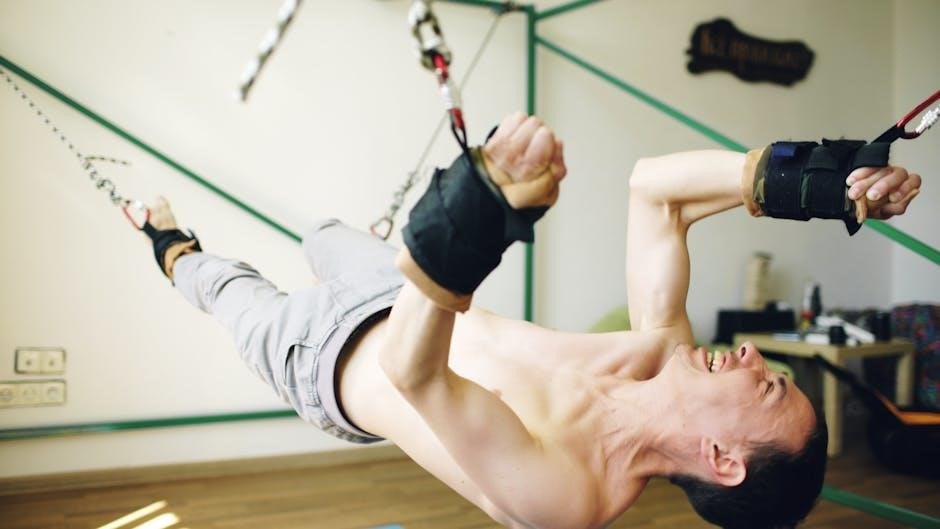
Embarking on suspension training requires proper setup, understanding fundamental exercises, and mastering correct body positioning for safe and effective gym-free workouts.
Setting Up Your Suspension Trainer
Proper setup is crucial for a safe and effective suspension training experience. Begin by securely anchoring your trainer to a sturdy overhead point – a robust door frame with an appropriate anchor, a pull-up bar, or a dedicated suspension point are all viable options.
Ensure the anchor can withstand your body weight and the dynamic forces generated during exercises. Adjust the straps to equal lengths, verifying they are securely fastened and free from any tears or damage.
Before each workout, double-check all connections. The trainer should hang with the handles at a comfortable height, generally around waist level, allowing for a full range of motion without obstruction.
Familiarize yourself with the adjustment mechanisms to easily modify strap length during exercises, altering the difficulty level. A stable and correctly installed trainer is the foundation for maximizing benefits and minimizing risk.
Basic Suspension Trainer Exercises
Mastering fundamental movements is key before progressing to advanced suspension training. Begin with the Suspension Plank, engaging your core to maintain a straight line from head to heels, utilizing the trainer for stability.
Next, practice Suspension Chest Presses, leaning back at an angle and performing a pushing motion, focusing on controlled movements. Follow this with Suspension Rows, pulling your chest towards the handles, squeezing your shoulder blades together.
Introduce Suspension Squats, maintaining a neutral spine and controlling your descent, using the trainer for assistance and balance. These exercises build a foundation of strength and stability.
Remember to prioritize proper form over speed or repetitions, ensuring each movement is executed with precision and control. Consistent practice of these basics will unlock more complex exercises.
Understanding Body Positioning & Form
Proper form is paramount in suspension training to maximize effectiveness and prevent injury. Maintaining a straight line from head to heels during exercises like planks and rows is crucial for core engagement.
Adjusting your body angle significantly alters the difficulty; the more inclined you are, the harder the exercise becomes. Focus on controlled movements, avoiding jerky motions or swinging.
Engage your core muscles throughout each exercise to stabilize your body and maintain proper alignment. Keep your shoulders retracted and down, preventing rounding of the back.
Visualize a neutral spine, avoiding excessive arching or flattening. Prioritize quality over quantity, performing fewer repetitions with perfect form rather than many with compromised technique.
Full Body Suspension Trainer Workouts
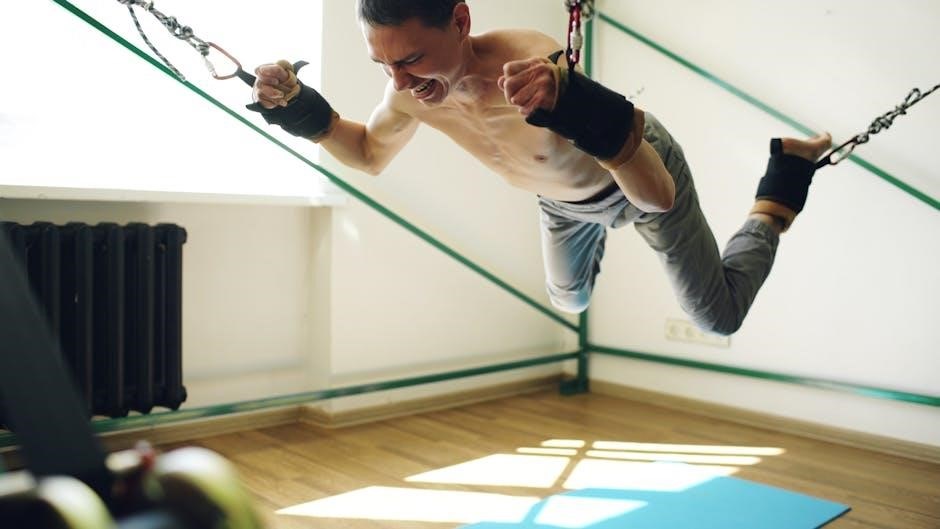
Suspension training delivers a comprehensive workout, targeting all major muscle groups through versatile exercises, offering a dynamic and effective fitness experience.
Chest & Back Exercises
Developing a strong upper body is easily achievable with suspension trainer workouts, focusing on both pushing and pulling movements. The Suspension Chest Press effectively mimics a traditional bench press, but utilizes bodyweight and instability for increased muscle activation.
Adjusting your body angle alters the difficulty, making it accessible for all fitness levels. Conversely, Suspension Rows target the back muscles, promoting posture and strength. Maintaining proper form – a straight line from head to heels – is crucial for maximizing effectiveness and preventing injury.
These exercises build foundational strength and endurance, contributing to a well-rounded physique. Integrating these movements into a routine provides a challenging yet rewarding workout, suitable for both beginners and advanced users seeking a versatile training method.
Suspension Chest Press
The Suspension Chest Press is a fantastic exercise for building pectoral strength and definition, utilizing your bodyweight as resistance. Begin by facing away from the anchor point, holding the handles with palms facing each other. Lean forward, maintaining a plank position with a straight line from head to heels.
Lower your chest towards your hands, keeping your elbows at a 45-degree angle. Push back to the starting position, squeezing your chest muscles at the top of the movement. Adjusting your body angle directly impacts the difficulty; the more upright you are, the easier the exercise becomes.
Focus on controlled movements and proper form to maximize effectiveness and minimize risk of injury. This exercise effectively mimics a traditional bench press, offering a unique challenge due to the instability of the suspension trainer.
Suspension Rows
Suspension Rows are excellent for developing back strength, improving posture, and enhancing upper body pulling power. Start facing the anchor point, grasping the handles with palms facing each other. Lean back, maintaining a straight line from head to heels, creating tension in the straps.
Pull your chest towards the handles, squeezing your shoulder blades together. Keep your elbows close to your body throughout the movement. Slowly lower yourself back to the starting position, controlling the descent. The further you lean back, the more challenging the exercise becomes.
Maintaining a rigid core is crucial for stability and preventing unwanted rotation. This exercise effectively targets the lats, rhomboids, and traps, contributing to a well-rounded upper body workout.
Core Exercises
Core strength is fundamental for overall stability and efficient movement, and suspension trainers provide unique challenges to engage these muscles. Unlike traditional floor exercises, the instability of the straps forces constant core activation.
Exercises like Suspension Planks and Suspension Mountain Climbers significantly increase the intensity of standard core work. Planks require maintaining a straight body line while battling the pull of the straps, demanding immense core control.
Mountain climbers, performed in suspension, amplify the challenge by adding a dynamic movement, further engaging the abdominal muscles and obliques. These exercises build a strong, functional core, improving balance and athletic performance.
Suspension Planks
Suspension Planks elevate the traditional plank by introducing instability, dramatically increasing core engagement. With feet secured in the foot cradles, the body must actively resist rotation and maintain a rigid, straight line from head to heels.
This exercise isn’t just about holding a position; it’s a constant battle against gravity and the trainer’s pull, forcing deep core activation. Beginners can start with shorter holds, gradually increasing duration as strength improves.
Proper form is crucial – avoid sagging hips or arching the back. Focus on squeezing the glutes and drawing the navel towards the spine. Suspension planks build incredible core strength, stability, and endurance, translating to improved performance in other exercises.
Suspension Mountain Climbers
Suspension Mountain Climbers transform a classic cardio and core exercise into a significantly more challenging movement. By placing your feet in the suspension trainer’s foot cradles, you introduce instability, demanding greater core control and full-body engagement.
The exercise involves driving your knees towards your chest in an alternating running motion while maintaining a plank position. This requires constant stabilization to prevent unwanted rotation or swinging. Focus on maintaining a strong core and controlled movements.
This variation boosts cardiovascular fitness, strengthens the core, and improves coordination. Beginners can modify by slowing down the pace or reducing the range of motion. It’s a dynamic exercise for building endurance and functional strength.
Leg & Glute Exercises
Leg and glute exercises with a suspension trainer offer a unique challenge, leveraging bodyweight and instability to maximize muscle activation. These exercises effectively target major lower body muscle groups, promoting strength, power, and functional movement patterns.
The instability inherent in suspension training forces constant core engagement, enhancing overall stability and balance. Exercises like Suspension Squats and Suspension Lunges demand greater control and coordination compared to traditional variations.
Adjusting the trainer angle allows for progressive overload, increasing or decreasing the difficulty. These exercises are scalable for all fitness levels, making them a versatile addition to any workout routine, building lower body strength efficiently.
Suspension Squats
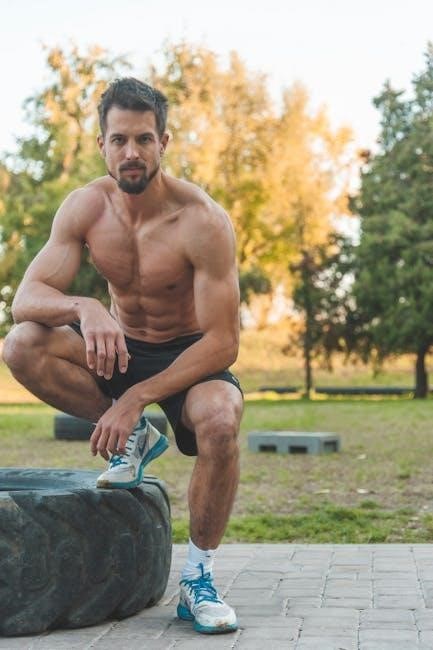
Suspension Squats are a fantastic lower body exercise utilizing a suspension trainer to amplify the traditional squat. By suspending your feet in the straps, you introduce instability, demanding greater core engagement and muscular control throughout the movement.
This variation increases the activation of glutes, hamstrings, and quadriceps, leading to improved strength and muscle endurance. Maintaining proper form – a straight back, engaged core, and controlled descent – is crucial for maximizing benefits and preventing injury.
Adjusting the foot strap length alters the difficulty; a more horizontal position increases the challenge. Suspension squats are highly scalable, making them suitable for various fitness levels, and a key component of effective leg workouts.
Suspension Lunges
Suspension Lunges elevate the standard lunge by introducing instability through the suspension trainer, significantly enhancing core activation and balance. One foot is secured in the straps while the other remains firmly planted on the ground, initiating a controlled lunge movement.
This variation demands greater stabilization from the supporting leg and core muscles, resulting in improved functional strength and coordination. Maintaining a neutral spine and preventing the knee from extending past the toes are vital for safe and effective execution.
Adjusting strap length modifies the difficulty; a more angled position increases the challenge. Suspension lunges are a versatile exercise, adaptable for all fitness levels, and a valuable addition to any lower body routine.
Arm & Shoulder Exercises
Suspension training offers a dynamic approach to sculpting and strengthening the arms and shoulders, utilizing bodyweight and instability for enhanced results. These exercises effectively target multiple muscle groups simultaneously, promoting functional strength and improved joint stability.
Key movements include Suspension Bicep Curls, where maintaining a consistent body angle is crucial for isolating the biceps, and Suspension Tricep Extensions, demanding core engagement to prevent unwanted rotation;
Adjusting the trainer angle allows for progressive overload, increasing the difficulty as strength improves. These exercises are highly adaptable, suitable for various fitness levels, and contribute to well-rounded upper body development.
Suspension Bicep Curls
Suspension Bicep Curls are a fantastic exercise for isolating and strengthening the biceps using your bodyweight and the instability of the trainer. Maintaining proper form is paramount; keep your body in a straight line from head to heels, engaging your core throughout the movement.
To perform the curl, pull your chest towards the anchor point, keeping your elbows high and close to your body. Control the descent, resisting the pull of gravity. Adjusting your foot position alters the difficulty – the further your feet are from the anchor, the harder the exercise becomes.
Focus on squeezing the biceps at the peak contraction and avoiding swinging or using momentum. This exercise builds both strength and endurance in the biceps, contributing to a more toned and defined upper arm.
Suspension Tricep Extensions
Suspension Tricep Extensions effectively target the triceps, the muscles on the back of your upper arms, utilizing bodyweight resistance and the inherent instability of the suspension trainer. Proper execution is crucial for maximizing results and preventing injury; maintain a stable plank position throughout the exercise.
Begin facing away from the anchor point, gripping the handles with palms facing each other. Extend your arms, pushing your body away from the anchor, focusing on contracting the triceps. Slowly lower yourself back to the starting position, controlling the movement.
Adjusting your body angle influences the difficulty; leaning further forward increases the challenge. Concentrate on keeping your elbows tucked in and avoiding flaring them out. This exercise builds tricep strength and definition.
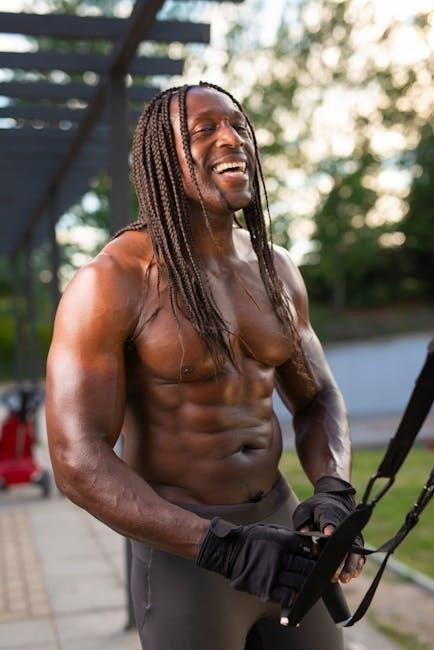
Advanced Suspension Trainer Techniques
Progressive overload, adjusting trainer angle, and combining exercises are key to continually challenging your muscles and maximizing gains with suspension training.
Progressive Overload in Suspension Training
Progressive overload is fundamental to continued strength gains, and suspension training offers unique ways to implement it. Unlike fixed weights, you control the resistance by adjusting your body position.
To increase difficulty, gradually decrease the trainer angle; a more horizontal position demands greater muscular effort. Another method involves slowing down the tempo of each repetition, increasing time under tension.
Consider adding repetitions or sets as you get stronger, or transition to more challenging exercise variations. For example, progress from a standard suspension chest press to a single-arm variation.
Carefully tracking your workouts – sets, reps, and angle adjustments – is crucial for monitoring progress and ensuring consistent overload. This data informs future workout planning and prevents plateaus.
Remember, small, incremental increases are more sustainable and effective than attempting large jumps in difficulty, minimizing risk of injury and maximizing long-term results.
Adjusting Trainer Angle for Difficulty
The beauty of suspension training lies in its adjustable resistance, primarily controlled by altering the trainer angle. A steeper angle reduces the load, making exercises more accessible for beginners or for mastering proper form.
Conversely, lowering the angle significantly increases the difficulty, demanding greater strength and stability. This principle applies to nearly all exercises, from suspension squats to rows and chest presses.
Think of it as a lever: the closer your body is to perpendicular with the straps, the easier the exercise; the more horizontal you become, the harder it gets.
Experiment with small angle adjustments to find the optimal challenge level. Prioritize maintaining correct form over achieving a drastically low angle initially.
Consistent adjustment allows for continuous progressive overload, ensuring ongoing muscle adaptation and preventing plateaus in your fitness journey.
Combining Exercises for Compound Movements
To maximize efficiency and challenge your body further, integrate compound movements within your suspension trainer workouts. This involves seamlessly transitioning between exercises, minimizing rest and engaging multiple muscle groups simultaneously.
For example, follow a suspension chest press immediately with suspension rows, creating a push-pull sequence that targets both chest and back. Or, combine squats with an overhead press, enhancing lower body strength and shoulder stability.
These combinations elevate the intensity and metabolic demand, leading to greater calorie expenditure and improved functional fitness.
Focus on controlled transitions and maintain proper form throughout the entire sequence.
Strategic exercise pairings can transform a standard routine into a dynamic, full-body workout, optimizing your time and results with your TRX or similar system.
Creating Your Suspension Trainer Workout PDF
Workout structure, sets, and reps are crucial for a successful suspension trainer program; tracking progress via workout logs ensures consistent improvement.
Workout Structure & Sets/Reps
Designing a suspension trainer workout PDF requires careful consideration of structure and intensity. A balanced routine should incorporate exercises targeting all major muscle groups – chest, back, core, legs, arms, and shoulders.
For beginners, start with 2-3 sets of 10-12 repetitions per exercise, focusing on proper form over speed. As strength increases, progressively overload by increasing repetitions to 15-20, then sets to 3-4.
Intermediate users can explore variations like slowing down the eccentric (lowering) phase or adding pauses at the most challenging point of the movement. Advanced athletes might incorporate plyometric variations or combine exercises for compound movements.
Rest periods between sets should be between 60-90 seconds for strength-focused workouts and 30-60 seconds for endurance-based routines. Remember to include a warm-up and cool-down in your PDF for optimal results and injury prevention.
Sample Workout Routines for Different Levels
A comprehensive suspension trainer workout PDF should cater to varying fitness levels. For beginners, a routine might include 3 sets of 10 reps of Suspension Chest Press, Rows, Squats, and Planks, with 60 seconds rest.
Intermediate athletes could progress to 3-4 sets of 12-15 reps, adding exercises like Suspension Lunges, Bicep Curls, and Tricep Extensions, reducing rest to 45-60 seconds.
Advanced users can implement circuits with minimal rest, incorporating plyometric Lunges, Mountain Climbers, and complex movements like a Chest Press to Row combination. Consider supersets pairing opposing muscle groups.
Each level’s PDF section should detail proper form, modifications, and progression options. Including visual aids, like exercise demonstrations, enhances usability and ensures safe, effective training.
Tracking Progress & Workout Logs
A valuable suspension trainer workout PDF incorporates tools for monitoring improvement. Dedicated workout logs within the PDF allow users to record sets, reps, trainer angle adjustments, and perceived exertion for each exercise.
Tracking these metrics reveals patterns and plateaus, guiding adjustments to maintain progressive overload. Include sections for noting bodyweight changes and any modifications made due to limitations or injuries.
Visual progress tracking, like charting reps over time, can be highly motivating. The PDF should suggest frequency of assessment – weekly or bi-weekly – to evaluate gains.
Consider including space for personal notes on form, challenges, and successes, fostering a mindful approach to training and maximizing the benefits of suspension workouts.
Safety Considerations
Suspension trainer workout PDFs must emphasize proper warm-up routines and cool-downs, alongside guidance on avoiding common form errors and injury modifications.
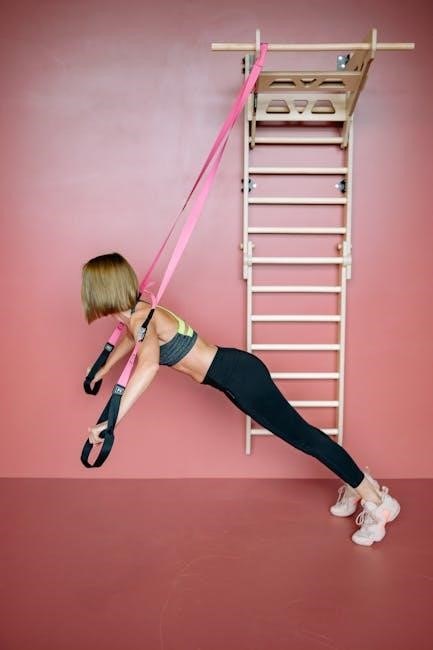
Proper Warm-up & Cool-down
Suspension trainer workout PDFs should dedicate significant space to outlining effective warm-up and cool-down protocols. A dynamic warm-up, including arm circles, leg swings, and torso twists, prepares muscles and joints for the demands of suspension training, minimizing injury risk.
Prior to beginning any workout, five to ten minutes of light cardio, like jogging in place or jumping jacks, is also beneficial. The warm-up should specifically target the muscle groups that will be engaged during the session.
Cool-downs are equally crucial, focusing on static stretching to improve flexibility and reduce muscle soreness. Holding each stretch for 20-30 seconds allows muscles to lengthen and recover. A well-structured cool-down aids in preventing post-exercise stiffness and promotes overall recovery.
PDF guides should include visual examples of appropriate warm-up and cool-down exercises, ensuring users understand correct form and technique.
Avoiding Common Mistakes
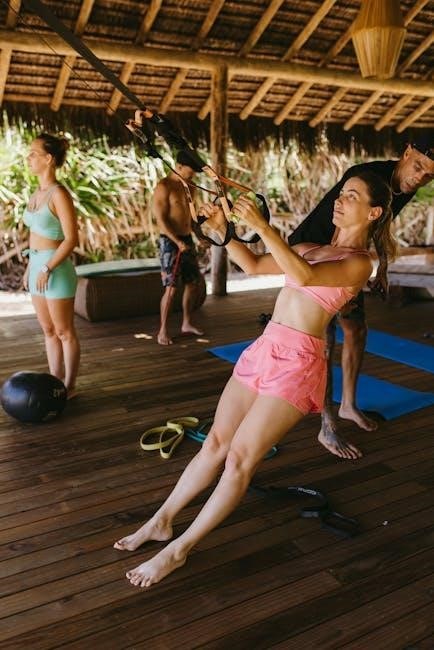
Suspension trainer workout PDFs must address frequent errors to ensure user safety and effectiveness. A primary mistake is maintaining poor body positioning – failing to keep a straight line from head to heels during exercises like planks or rows.
Another common issue is relying too heavily on momentum instead of controlled muscle engagement. Users should focus on slow, deliberate movements, maximizing time under tension. Overextending joints, particularly the elbows and shoulders, is also a significant risk.
PDF guides should visually demonstrate correct form and highlight common pitfalls. Emphasizing the importance of core engagement throughout each exercise is vital. Ignoring proper strap adjustment, leading to instability, is another frequent error to address.
Finally, progressing too quickly without mastering foundational movements can increase injury risk.
Modifications for Injuries & Limitations
Suspension trainer workout PDFs should comprehensively cover exercise modifications for individuals with injuries or physical limitations. For shoulder issues, reducing the angle of incline in chest presses or rows minimizes stress. Individuals with lower back pain can modify planks by performing them on their forearms or knees.
Knee problems necessitate shallower squats or modified lunges, focusing on controlled movement within a pain-free range. Wrist discomfort can be addressed by using a neutral grip or utilizing push-up handles;
PDFs should clearly illustrate these alternatives, emphasizing the importance of listening to one’s body and avoiding movements that exacerbate pain. Consulting a healthcare professional before starting any new exercise program is crucial.
Progressive adaptation is key; start with easier variations and gradually increase difficulty as strength and mobility improve.